After having several days off, I finished another non-fiction book and what a book it was: "The Devil in the White City" by Erik Larson.
It tells the history of two extremes, Daniel Burnham and others involvement in the incredible World Colombian Exhibition in Chicago 1892 as well as America's first known serial killer Herman Webster Mudgett aka H.H. Holmes.
The writing style was exceptionally done with teases and parceled out knowledge to lead the reader in a journey about these two separate but linked events. What also struck me are the reciprocal things and moments from the exhibition that led to innovations and ideas which changed history, some for the better and some for the worse. It had me wanting to read the next chapter after each one was finished. The exhibition itself would be a wondrous place to be...as long as one did not stay at Mr Holmes' hotel. Highly recommended.
Headings
Food
(530)
History
(429)
Travel
(259)
art
(232)
maritimes
(182)
Spain
(165)
France
(138)
Vancouver Island
(136)
UK
(96)
Portugal
(81)
Postcard of the Interwebs
(70)
Musings
(50)
Tofino
(47)
Scandinavia
(44)
book
(43)
Italy
(39)
Hornby
(31)
Movie and TV
(27)
Music
(24)
Conventions
(23)
Wisdom without Zealotry
(17)
Quadra Island
(12)
San Francisco
(11)
Ottawa
(5)
Saturday, 23 March 2019
Saturday, 16 March 2019
Two books on Acadian Life and their Explusion
In the first three months of this year, I finished two books on the history of the Acadians, who were the French colonists and their descendants in the Maritime Provinces of Canada. These were “History of Port Royal/Annapolis Royal: 1605-1800” by Brenda Dunn and “A Great and Noble Scheme: The Tragic Story of the Expulsion of the French Acadians from their American Homeland” by John Mack Faragher.
Both books look at the
settlement of the Maritime Provinces by French settlers in the early 1600’s to
the mid 1700’s and beyond. I enjoyed the descriptions of notable persons,
events, and life in particular the research done for factual documents that
were made during their lifetimes. The close relations the Acadians had with the
Micmaq peoples made this group a valuable resource and ally during the conflicts
between the Britain and New England Colonists vs the French governments. The
thing that was poignant for me was the Acadians’ desire to be neutral in these frequent
conflicts which made these outsider countries afraid of the Acadian presence or
frustrated at their lack of support. Unfortunately their desire to be left
alone was not to be and the British and American colonists forced them out of
their multi-generational new homeland causing many thousands of deaths.
Brenda Dunn’s book
focuses on the region around Port Royal/Annapolis Royal and is a shorter work
at around 200 pages. John Faragher’s work goes into more detail, with 480 pages, into the
overall picture of the historical events as well as making a strong case for
British and American colonists’ ethnic cleansing of the Acadian people. A short brief of his book is available here.
I would recommend the
second book for its detail. If you do not have a long time to read I would go
with the first one, which may be available at cover price in Annapolis Royal,
Nova Scotia, where I bought it.
Friday, 15 February 2019
Ottawa - National Gallery of Canada
The National Gallery of Canada was a perfect place to unwind after meeting with many people and sitting through presentations. I stayed for 3.5 hours and enjoyed the visit.
I liked the walkway to the main level with incredibly tall ceilings, windows to the outside, and a blank wall on the inside. It was a great way to clear the mind and take a deep breath.
There is a nice garden in the center of the building, that can also be used to take a break and steady the mind before diving in again.
The displays are well orientated, well lit, and have an appropriate length in explanation text beside the works.
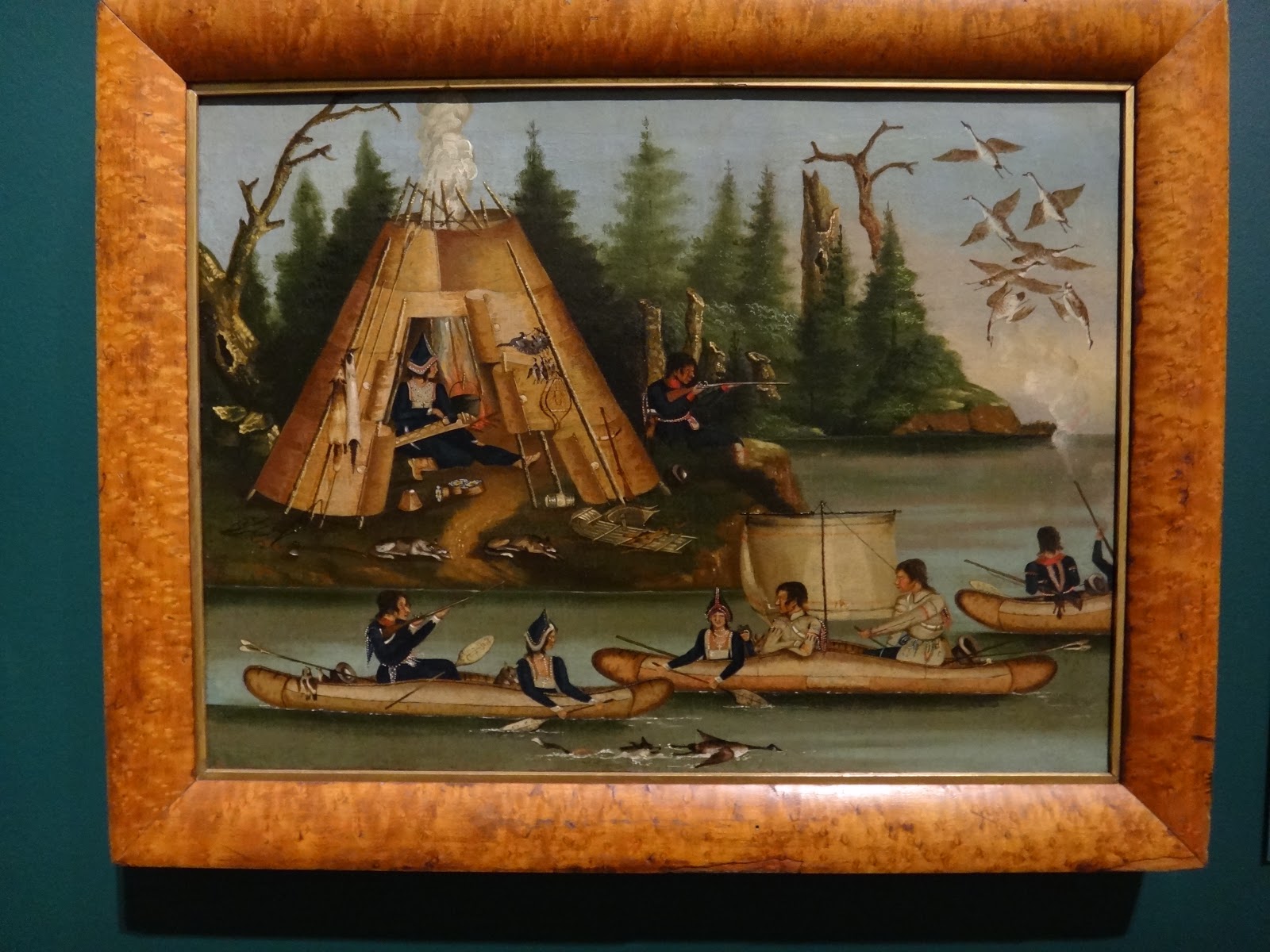
This work was by an unidentified artist who painted a very accurate depiction of Mikmaw who inhabit the Maritime provinces of Canada. It was done in 1850.
This is Laurentian Splendor by John A. Fraser in 1880. I really like the colours and calm tone of the work.
This is Snow 2 by Lawren S. Harris in 1915. The layers of snow are expertly painted to give a realistic feeling of walking through the woods after a snowfall.
This is The Upper Ottawa near Mattawa by Franklin Carmichael in 1924. I quite like the way he painted the tree and rocks.
This is Gleams on the Hills by J.E.H. MacDonald in 1921. The overlapping multi coloured forest around the hill and river are expertly done.
This is Vera by F.H. Varley in 1930. I like the way he painted this portrait.
I am not a fan of modern art but Ascending Forms by Bertram Booker in 1929 is an exception.
The gallery has many many more paintings from all parts of the world as well as special exhibits and gatherings. When I left they were revving up a soiree for a film. I'd come back again in ten years with my wife to see what is new and revisit my favorites.
I liked the walkway to the main level with incredibly tall ceilings, windows to the outside, and a blank wall on the inside. It was a great way to clear the mind and take a deep breath.
There is a nice garden in the center of the building, that can also be used to take a break and steady the mind before diving in again.
The displays are well orientated, well lit, and have an appropriate length in explanation text beside the works.
This work was by an unidentified artist who painted a very accurate depiction of Mikmaw who inhabit the Maritime provinces of Canada. It was done in 1850.
This is Laurentian Splendor by John A. Fraser in 1880. I really like the colours and calm tone of the work.
This is Snow 2 by Lawren S. Harris in 1915. The layers of snow are expertly painted to give a realistic feeling of walking through the woods after a snowfall.
This is The Upper Ottawa near Mattawa by Franklin Carmichael in 1924. I quite like the way he painted the tree and rocks.
This is Gleams on the Hills by J.E.H. MacDonald in 1921. The overlapping multi coloured forest around the hill and river are expertly done.
This is Vera by F.H. Varley in 1930. I like the way he painted this portrait.
I am not a fan of modern art but Ascending Forms by Bertram Booker in 1929 is an exception.
The gallery has many many more paintings from all parts of the world as well as special exhibits and gatherings. When I left they were revving up a soiree for a film. I'd come back again in ten years with my wife to see what is new and revisit my favorites.
Ottawa - Parliament Buildings
Completed in 1927, the center block of the Canadian parliament buildings is where the house of commons for Canada is located. It also has offices, ceremonial chambers, library, and other federal governmental offices. The outside was all I saw because the inside is undergoing renovations expected to take 10 years. Its still very nice on the outside though with Gothic style architecture and many wonderful stone carvings.
This stone beaver is above the main door under the clock tower and looks tough as nails.
I do not know the symbolism for the unicorn having its tongue out, but I like it.
This owl is above the door going into the right side of the center block.
This is the back of the center block and the circular structure is the library of parliament, built in 1876 and the only structure to survive a fire in 1916.
I'd like to come back to Ottawa after the renovations are done to see the inside.
This stone beaver is above the main door under the clock tower and looks tough as nails.
I do not know the symbolism for the unicorn having its tongue out, but I like it.
This owl is above the door going into the right side of the center block.
This is the back of the center block and the circular structure is the library of parliament, built in 1876 and the only structure to survive a fire in 1916.
I'd like to come back to Ottawa after the renovations are done to see the inside.
Ottawa - Aroma Meze
Aroma Meze is an excellent Greek restaurant that specializes in small plates to share or get a good sampling of many items. Small seating area in an old house means its cozy but the well placed seating means you are not cramped.
Octopodaki. This took me back to eating in Greece! Fantastic.
Eggplant roulade. Solidly tasty.
Lamb chimichurri. The pesto and quality of lamb was divine.
The classic spanikopetia. Delicious!
I would definitely come here again.
Octopodaki. This took me back to eating in Greece! Fantastic.
Eggplant roulade. Solidly tasty.
Lamb chimichurri. The pesto and quality of lamb was divine.
The classic spanikopetia. Delicious!
I would definitely come here again.
Ottawa - Novotel
While in Ottawa I stayed at Novotel, an upscale place that my work put me up in. It is central to the old part of Ottawa and very near tourist attractions including the Byward market, Rideau canal, Parliament Buildings, and more. Being this close to the sights means a rental car is not needed for most destinations. The buffet breakfast is extensive and tasty. I'd stay here again if an equivalent conveniently located place was not available for a better price.
Ottawa - Joey Rideau
Joey Rideau is part of the Joey restaurant chain and is located in the heart of old town Ottawa. It had pleasant music playing and friendly, helpful staff.
I had the mushroom soup, which was quite tasty and soothing for a cold winter night.
My main was the Spaghetti Pomodoro (Calabrian chili spiked tomato sauce, whipped ricotta, fresh basil, Parmesan) and was delicious and filling. With this I had a Louis M. Martini Cabernet Sauvignon from Sonoma, which was very tasty.
I recommend this chain for above average consistent food.
I had the mushroom soup, which was quite tasty and soothing for a cold winter night.
My main was the Spaghetti Pomodoro (Calabrian chili spiked tomato sauce, whipped ricotta, fresh basil, Parmesan) and was delicious and filling. With this I had a Louis M. Martini Cabernet Sauvignon from Sonoma, which was very tasty.
I recommend this chain for above average consistent food.
Location:
50 Rideau St, Ottawa, ON K1N 9J7, Canada
Subscribe to:
Posts (Atom)